


Quick Summary
Ten fully outfitted glamping pod units shipped to Southeast Asia will run somewhere between $250,000 and $270,000 all-in. At $150 per night with 68% annual occupancy, you’re looking at full payback in around ten months. Every unit leaves the factory with the interior already finished — flooring, bathroom, air conditioning, smart controls, the works. You hook up water and power on site, and guests can check in that evening. The structure carries a 30-year warranty, handles winds up to Level 9, and operates reliably from -40°C to 46°C.
This guide is written for:
- First-time glamping investors who need real cost numbers before approaching a bank or a business partner
- Resort owners considering whether glamping pod units make financial sense on their existing property
- Landowners sitting on scenic land and wondering what to build
- Anyone who wants to understand the ROI model before picking up the phone to a supplier
If that sounds like you, keep reading.
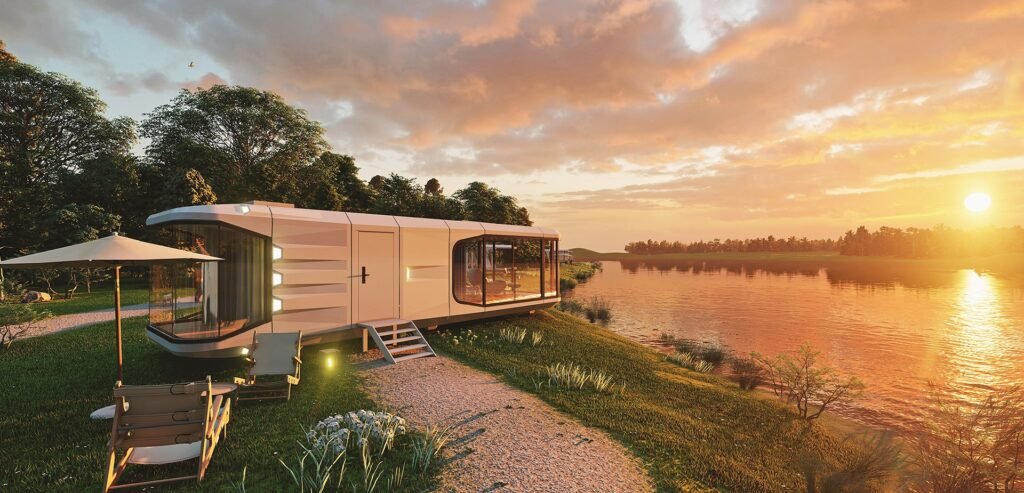
A Note on Terminology
Throughout this guide, you’ll see the terms space capsule house, glamping pod, luxury glamping pod, and prefab glamping cabin used — sometimes interchangeably. They refer to the same category of product: factory-built, fully fitted, relocatable accommodation units designed for high-end outdoor hospitality. The terminology varies by region. Buyers in Australia and the UK tend to search for “glamping pods.” North American operators often look for “modular glamping cabins” or “prefab glamping pods.” In Asia and the Middle East, “space capsule house” is the dominant term. Whatever you call them, the product — and the investment logic — is the same.
Why Glamping Pods Beat Tents and Log Cabins — An Honest Comparison
Before committing to any glamping product, it’s worth laying the three most common options side by side. The differences aren’t subtle.
| Feature | Luxury Tent | Log / Light Steel Cabin | Glamping Pod / Space Capsule House |
| Time from order to guest-ready | 1–2 weeks | 3–12 months | 1 day (crane-set, connect utilities, done) |
| Structural lifespan | 5–8 years | 20–30 years | 30+ years (frame + shell: 30-year warranty) |
| Wind resistance rating | Low | Medium | Level 9 |
| Social media appeal | Low | Medium | Very high — guests photograph and share without prompting |
| Winter operability | Poor | Moderate | Strong (underfloor heating option; -40°C rated with upgrade) |
| Extreme heat tolerance | Poor | Moderate | Strong (46°C+ with proper insulation and AC) |
| Coastal salt corrosion resistance | Poor | Moderate | Excellent (aviation-grade aluminum; all wiring in sealed conduits) |
| Relocatability | High | Near-zero | High (25-ton crane lifts the entire unit) |
| Ongoing maintenance | High | Moderate | Minimal — wipe down the exterior, that’s about it |
| Entry cost per unit | $3,000–8,000 | $20,000–60,000+ | $11,000–37,800 |
Tents are cheap to start but expensive to maintain and replace, and they shut down in winter. Cabins last, but you’re looking at a construction project, not a product delivery — months of contractors, weather delays, and cost overruns before a single guest checks in.
Glamping pods and space capsule houses sit in the middle on upfront cost. But on every operational dimension — speed to revenue, maintenance burden, climate flexibility, and the one thing money genuinely can’t buy, the ability to make guests reach for their phones — capsule-style pods come out ahead. The aluminum shell is the same material class used in high-speed rail cars and airport terminals. It doesn’t rot, doesn’t need repainting, doesn’t corrode near saltwater. The interior arrives fully fitted. There is no parallel in the glamping market for that combination of cost, speed, and durability.
What’s Inside a Luxury Glamping Pod — The Full Specification
Structure and shell
The outer shell uses 3-series aviation-grade aluminum alloy panels with PVDF fluorocarbon baking paint — a liquid-applied coating that substantially outperforms powder coating on UV resistance, abrasion durability, and color retention. The main frame runs 3–4mm thick; aluminum face panels are 2mm; other structural components are 1.5–2mm. Frame and shell carry a 30-year structural warranty.
Insulation and glazing
Standard insulation is spray-applied polyurethane foam at 75–100mm, upgradeable to 200mm for cold-climate deployments. Most standard models come with triple-layer tempered floor-to-ceiling glass. The AE flat-pack series uses Low-E insulated tempered glass. For coastal installations, the aluminum shell is rated for salt spray exposure, and all electrical wiring is routed through sealed protective conduits.
The factory-finished interior — what “plug-and-stay” actually means
This is the detail that tends to surprise buyers who are used to conventional construction: every CGCH glamping pod ships with the interior completely finished. There is no interior construction work to arrange on site. No hiring local contractors to fit bathrooms. No fixtures arriving in separate shipments weeks later.
Standard equipment on every unit includes:
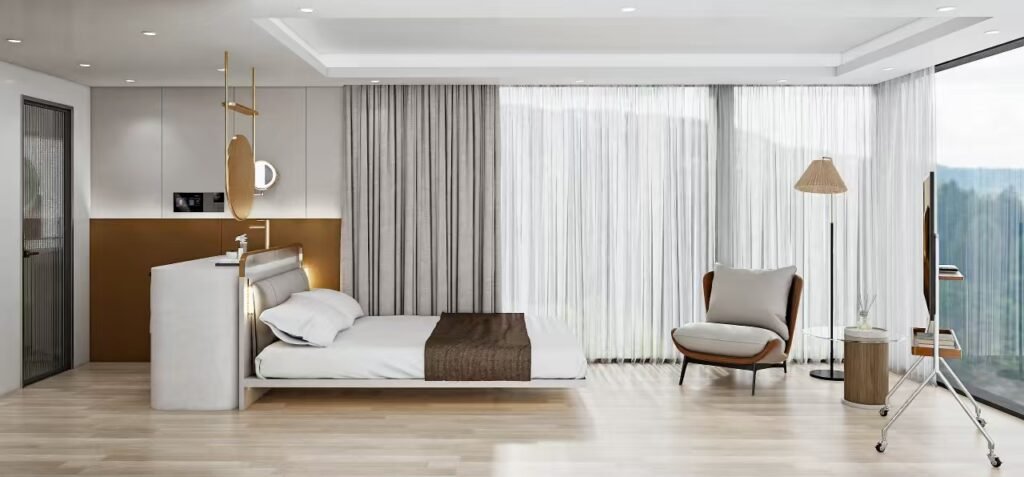
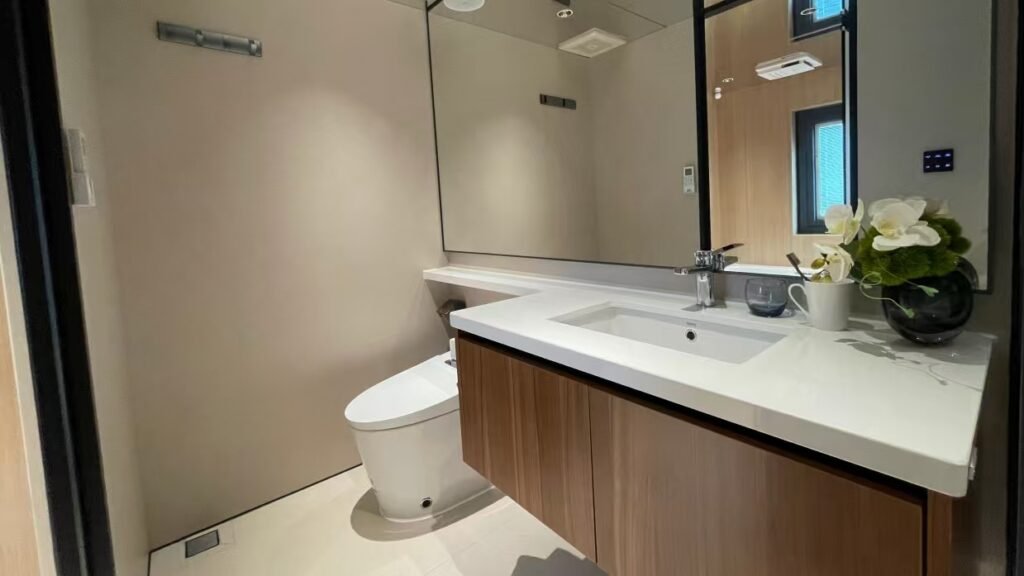
Interior finishes: Integrated ceiling and wall modules, stone crystal wood-grain flooring, bathroom privacy glass door, marble and tile shower floor, washbasin counter with sink and mirror, branded water faucet and showerhead with floor drain, towel rack, shower shelf, and coat hooks.
Electrical and mechanical systems: Whole-house lighting, electric curtains, hotel-grade smart access control, branded cooling and heating air conditioner, electric water heater, full ventilation system, whole-house mosquito-proof screen doors, branded smart toilet, 4-in-1 bathroom heater unit covering light, heat, ventilation, and fan, and electric underfloor heating.
Smart controls: Multi-scene mode control panel with voice control, standard on most models. The K-series uses a separate smart control configuration.
Available upgrades at additional cost: UV-resistant insulating window film, thickened insulation layer, starry sky skylight, projector and screen, custom bar counter or wardrobe, full kitchen integration including cabinets, range hood, induction cooktop and refrigerator, washing machine, heated towel rack, entrance staircase, triangular V-brace support, and entrance platform.
Electrical specifications (two-bedroom reference model): Full load approximately 10kW; normal operating draw approximately 1.2kWh per hour; sized for two 1.5HP air conditioning units. Voltage and outlet configuration are customized to your country’s standard at no additional cost — just provide a photo of your local outlet type when ordering.
Every unit undergoes a full water spray test before leaving the factory — simulating heavy rain conditions — and must pass with zero leakage before it is cleared for shipment.
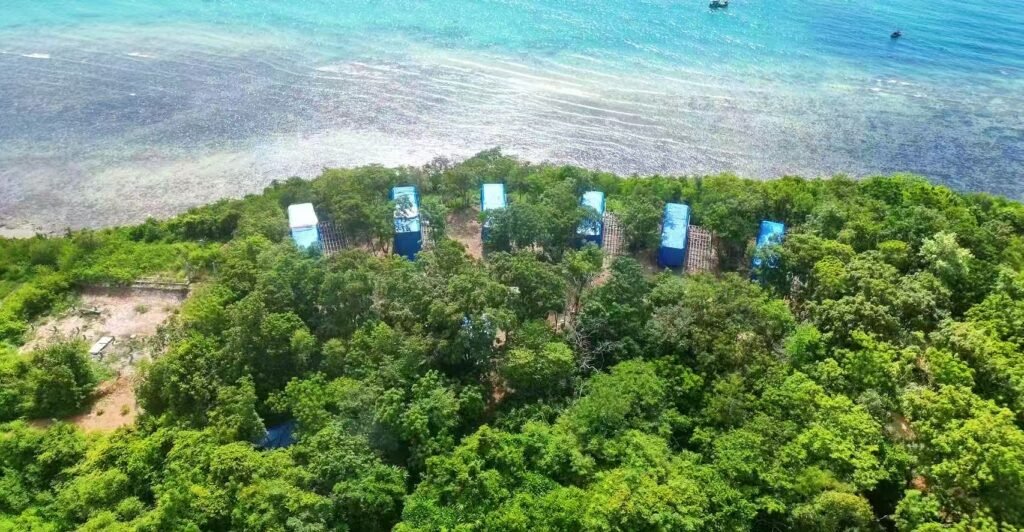
How Much Does It Cost to Start a Glamping Pod Business?
Investment breakdown
Base case: 10 units, mid-size glamping pod (approximately 31㎡, bulk order price $16,900 per unit).
Product cost: $16,900 × 10 = $169,000
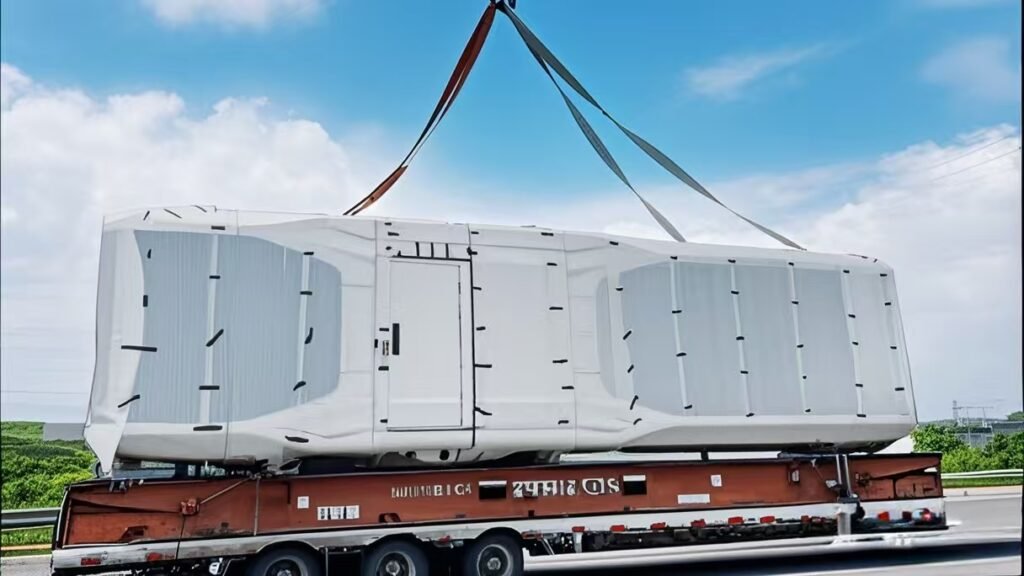
Shipping: Fully assembled glamping pods require 40FR flat-rack shipping containers — not standard 40HQ high-cube containers, which cannot accommodate the assembled units. Each 40FR holds 2 units, so 10 units require 5 containers. CIF freight costs by destination:
| Destination | Per 40FR container (CIF) | Total for 5 containers |
| Southeast Asia (Thailand / Indonesia / Philippines) | $5,500–7,000 | $27,500–35,000 |
| Middle East (Saudi Arabia / UAE) | $9,000–11,000 | $45,000–55,000 |
| Europe (Poland / Georgia) | $11,000–14,000 | $55,000–70,000 |
Additional costs:
| Cost item | Southeast Asia | Europe / Middle East |
| Foundation — screw piles, 10 units | $10,000 | $12,000 |
| Utility hookup — external water and electricity | $8,000 | $10,000 |
| Common areas — reception, landscaping, amenities | $20,000 | $25,000 |
| Contingency — approximately 10% | $23,000 | $30,000 |
Total investment by scenario:
| Scenario | Product | Shipping | Other costs | Total |
| Southeast Asia | $169,000 | $31,000 | $61,000 | ~$261,000 |
| Middle East | $169,000 | $50,000 | $77,000 | ~$296,000 |
| Europe | $169,000 | $62,000 | $77,000 | ~$308,000 |
How much can a glamping pod business make?
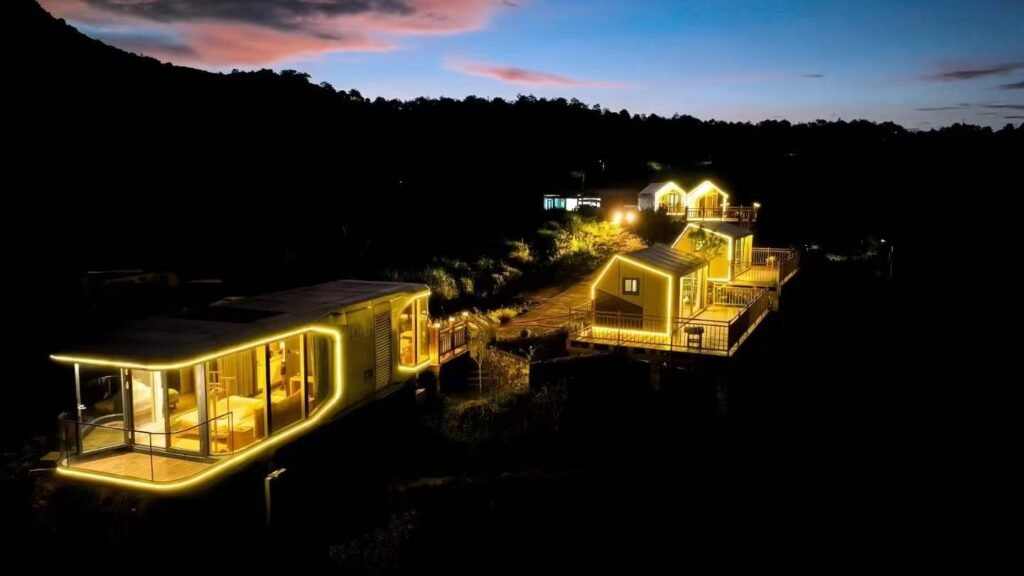
Luxury glamping pods placed on genuinely scenic sites consistently land in the mid-to-premium segment of local glamping markets. The floor-to-ceiling glass, the aerospace aesthetic, and the smart-home systems collectively justify rates that tent glamping simply cannot charge.
Market reference rates:
| Market | Estimated rate / night | Context |
| Southeast Asia — no distinctive view | $80–120 | Competitive OTA-driven markets |
| Southeast Asia — ocean or mountain view | $150–220 | Location creates the premium |
| Europe — Poland, Georgia, Turkey | $130–220 | Meaningful seasonal variation |
| Middle East — Saudi Arabia, UAE | $280–450 | Peak season runs October through April |
Annual projections for a 10-unit glamping pod site:
| Scenario | Rate / night | Occupancy | Annual revenue | Operating cost | Net profit | Payback |
| SE Asia — conservative | $100 | 60% | $219,000 | $50,000 | $169,000 | ~18 months |
| SE Asia — mid-case | $150 | 68% | $372,300 | $50,000 | $322,300 | ~10 months |
| SE Asia — optimistic | $200 | 75% | $547,500 | $55,000 | $492,500 | ~6 months |
| Europe — mid-case | $170 | 55% | $341,325 | $60,000 | $281,325 | ~13 months |
| Middle East — mid-case | $320 | 65% | $759,200 | $65,000 | $694,200 | ~5 months |
Annual operating cost breakdown: 2–3 staff ($15,000–25,000), utilities and maintenance ($8,000–12,000), OTA platform fees and marketing ($10,000–15,000), insurance ($3,000–5,000).
Put $261,000 into a 10-unit prefab glamping pod site in Southeast Asia, charge $150 per night, run at 68% annual occupancy, and you recover your full investment in roughly 10 months. After that, the operation runs on profit. Even in the most conservative scenario — $100 per night at 60% occupancy — you’re back to zero in 18 months on a product warranted to last 30 years. The financial case for prefab glamping pods holds up whether you’re building a boutique resort or testing the market with five units.
How to Choose the Best Location for a Glamping Site
You can buy the best glamping pod on the market and still fail. Site selection is what separates a full-occupancy operation from a half-empty one. Here is the framework to evaluate any location.
What’s outside the window
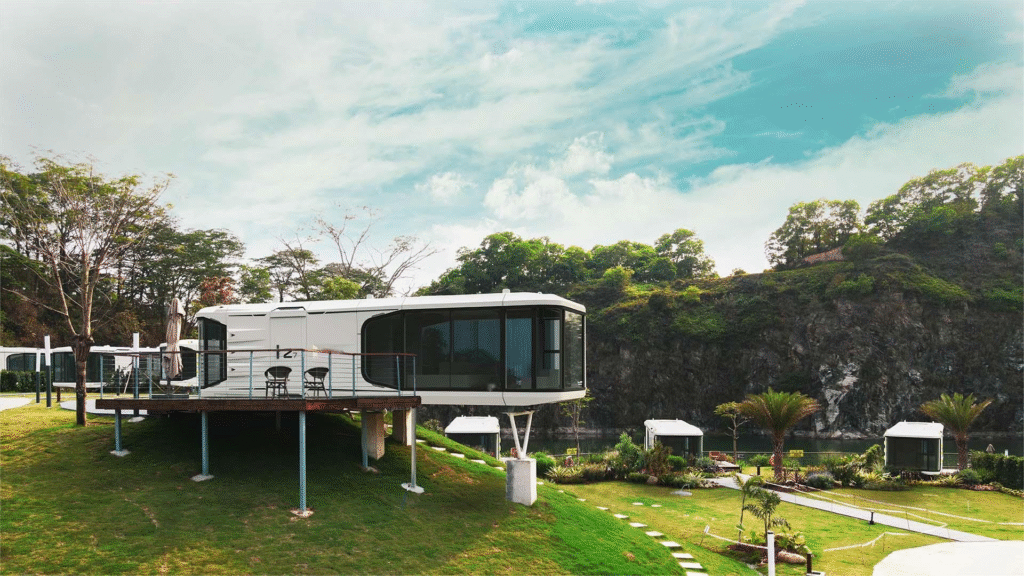
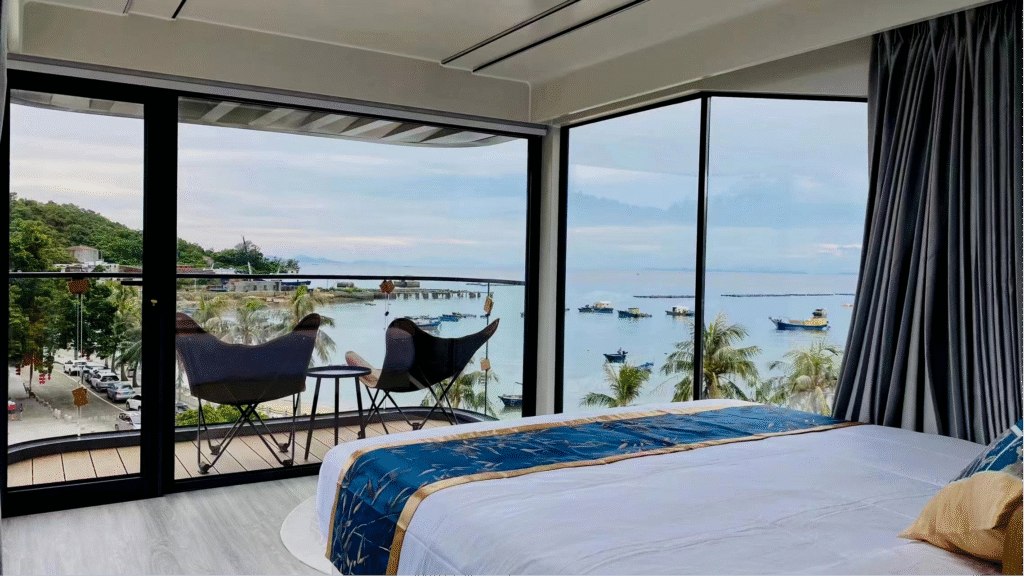
The floor-to-ceiling glass is the glamping pod’s signature feature. Without a view worth photographing, you’ve lost your premium before you’ve started. Ocean, mountain, lake, open grassland, desert — these five landscape types are the proven glamping categories. When planning your layout, orient every unit toward the best available view, not toward the easiest construction line.
Drive time from the nearest major city
The sweet spot is one and a half to three hours. Under an hour and the site doesn’t feel like a proper escape — guests treat it as a day trip, not an overnight stay. Over four hours and you lose the impulse booking market, which drives a substantial share of short-stay revenue, especially on weekends.
Infrastructure access
Because every glamping pod arrives fully fitted, the only work required on site is crane placement, foundation attachment, and utility connection. The project cost, however, is heavily influenced by how straightforward those connections are.
Power access matters significantly. Confirm the local grid can support approximately 10kW per unit at simultaneous full load. Voltage and outlet configuration are handled at the factory — just inform us of your local standard when ordering, and we configure every unit at no additional cost.
Water supply is worth evaluating early. Municipal connection is far cheaper than drilling a well or arranging water delivery. Road access is often overlooked: the delivery truck and the 25-ton crane both need a viable route to the site and sufficient clearance to maneuver.
Regulations and land status
In most countries, prefab glamping pods qualify as temporary or relocatable structures, which typically means a lighter permitting burden than permanent construction. The specifics vary significantly by jurisdiction — land designation, zoning classification, and local building authority interpretations all play a role.
The most expensive mistake a glamping developer can make is ordering units before confirming land rights and build permits. Units sitting in a port while a permit dispute gets resolved generate storage fees every day and can derail your entire opening timeline. Resolve the land situation first, confirm the regulatory path, then place your order.
Competition and first-mover advantage
The early operator in an emerging destination captures advantages that are genuinely difficult for later entrants to buy: the first concentration of positive OTA reviews, the first wave of local media attention, the first social media tags associated with that location. In Southeast Asia and the Middle East, several destinations are currently in that early window — the supply of distinctive, high-quality glamping accommodation is still thin relative to growing visitor numbers.
CGCH currently offers 26 space capsule and glamping pod configurations ranging from 14.6㎡ to 44.6㎡, with factory pricing from $11,000 to $37,800. Rather than specifying exact model numbers — which can shift with production schedules and availability — the four project scenarios below describe what to look for, and we will match the current best-fit options to your specific requirements.
Scenario 1 — Test and learn (total budget $80,000–130,000)
Five glamping pod units in the 15–20㎡ range is a legitimate way to enter the market without overcommitting capital. The target rate is $80 to $120 per night, the operation can realistically be managed by one person, and the data you collect on occupancy, guest feedback, and seasonal patterns becomes the basis for a confident second phase of investment. At this scale, mistakes are recoverable. The fully fitted interiors mean you can open quickly and start generating real-world performance data within weeks of delivery.
Scenario 2 — Standard glamping site (total budget $230,000–310,000)</h3>
Ten mid-size glamping pod units in the 30–38㎡ range represents the most common commercial starting point. A unit of this size accommodates a couple or a small family comfortably — bedroom area, living space, full bathroom — and at $130 to $200 per night, the ROI timeline is achievable without exceptional occupancy rates. Adding kitchen integration to some or all units allows a meaningful rate premium for guests who want self-catering flexibility.
Scenario 3 — Premium resort (total budget $380,000–520,000)
Ten to fifteen larger glamping pod units in the 38–44㎡ range, with a portion of the inventory using panoramic glazing configurations as the flagship offering. At $250 to $450 per night, the product justifies strong rate performance. The panoramic units should be priced at a 30–40% premium over standard units — this creates a tiered inventory that maximizes average rate and generates the kind of social media content that drives organic bookings.
Scenario 4 — International flagship development (total budget $600,000 and above)
Fifteen or more units using the AE flat-pack all-aluminum series at approximately 40㎡. The AE series ships disassembled in standard 40HQ high-cube containers — a significant freight cost reduction compared to 40FR flat-rack shipping, particularly relevant for Europe and the Middle East where per-container freight runs $11,000 to $14,000. Assembly is required on site; CGCH provides video installation guidance, and orders of 10 or more units can request on-site engineer support with the buyer covering travel costs. At $400 to $800 per night, this segment targets operators with hospitality experience who are building a destination product.
How Long Does It Take to Open a Glamping Pod Site? The 90-Day Timeline
Days 1 to 7: Specification and contract
Confirm model selection, unit count, exterior colors, voltage and outlet standard, and any upgrade options. Sign the purchase contract and transfer the 50% deposit. In parallel: finalize your site, commission foundation design based on CGCH drawings, advance any outstanding permit applications, and set up your OTA profiles so they are ready to publish when the units arrive.
Days 8 to 30: Factory production
CGCH’s Guangdong and Anhui factories handle standard export orders; the Saudi Arabia facility serves the Middle East region. Production for a standard batch runs approximately 30 working days. Every glamping pod unit completes a full water spray test before it is cleared for packing. While production is running, install screw pile foundations according to CGCH drawings and pre-lay external water and electrical connections to the unit positions.
Days 31 to 35: Final inspection and shipment
CGCH provides photo and video documentation of each completed unit. Once you confirm, pay the balance and authorize shipment. Units are loaded onto 40FR flat-rack containers and shipped.
Days 36 to 70: Ocean freight in transit
Southeast Asia destinations typically take 20 to 30 days from the China port. Middle East routes run 25 to 35 days. European destinations take 35 to 45 days. Use this window to complete common area construction, arrange your crane contractor, and finalize photography and platform content so you can publish listings the day the units land.
Arrival day: Crane placement and utility connection
A 25-ton crane is sufficient for most site configurations where the drop point is within 10 meters of the truck. Units are set onto the pre-installed foundations, secured, and connected to the pre-laid external utilities. That is the entirety of the on-site work. Guests can stay that evening.
Days 70 and beyond: Soft launch and opening
Bring in bedding and soft furnishings — typically three to five days of work. Shoot your photography. Publish your listings on Airbnb, Booking.com, and any relevant regional platforms. Invite local travel writers or content creators for hosted stays in exchange for coverage. Then open.
The total elapsed time from deposit to units on site runs 75 to 90 days for Southeast Asia. A conventional construction project in the same region would typically require 12 to 18 months before the first guest checks in. That gap represents 12 to 18 months of revenue that conventional construction simply cannot capture.
Real Glamping Pod Projects — What Happens When the Product Meets Extreme Conditions
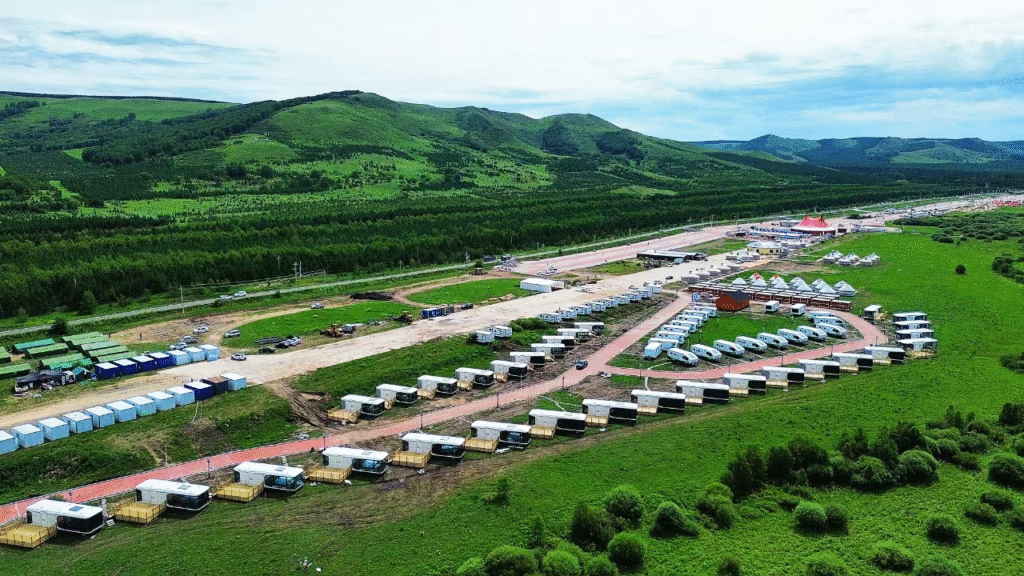
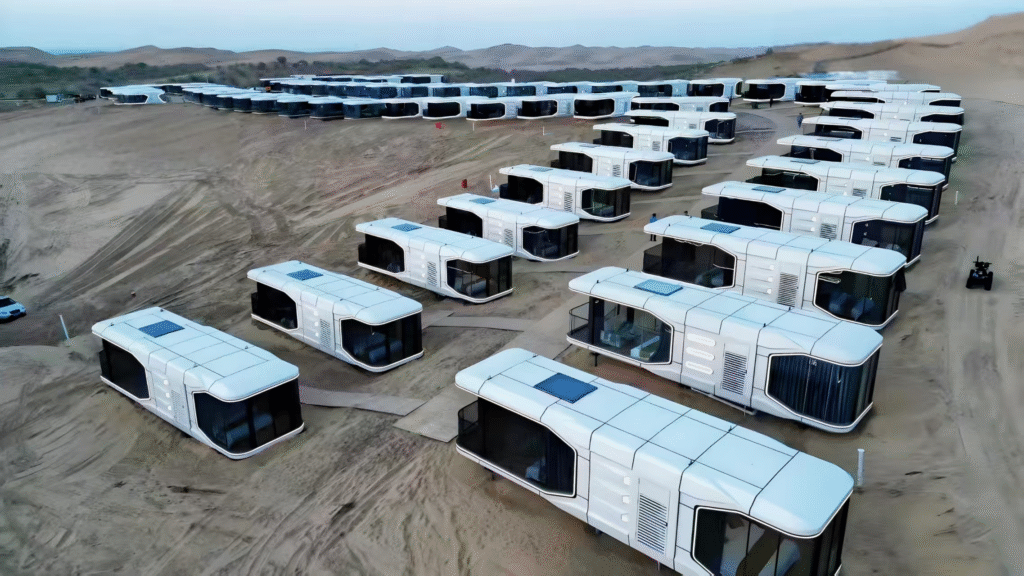
Inner Mongolia Grassland Resort — 60 Luxury Glamping Pod Units
This project in northern China faced a climate profile that tested both ends of the comfort range: winters dropping to -25°C, summers with intense UV radiation and daily temperature swings exceeding 30°C. The specification included 100mm PU foam insulation throughout, triple-layer tempered glass, electric underfloor heating for winter operation, and PVDF fluorocarbon coating on the exterior panels to resist UV-induced fading.
Peak season occupancy — June through September — ran above 85%. The rate premium over nearby tent camping was approximately 3x. The grassland panorama, delivered through floor-to-ceiling glass, converted directly into pricing power. The project validated that prefab glamping pods can operate at consistent quality through extreme temperature variation without requiring ongoing structural attention.
Saudi Arabia Desert Resort — 80 Luxury Glamping Pod Units
The challenge here was the opposite extreme: summer outdoor temperatures exceeding 46°C, frequent sandstorm exposure, and daily thermal swings of 30°C or more. The specification used 150mm composite insulation, Low-E triple-glazing to manage solar gain, high-capacity cooling and heating air conditioning, and aluminum panel systems with conduit-protected wiring throughout to resist sand infiltration.
Peak season — October through April — ran at over 90% occupancy. Nightly rates ranged from approximately $400 to $800. Saudi Arabia’s Vision 2030 tourism program has created sustained demand for high-quality desert accommodation, and this project became one of the reference properties in that category.
What both projects confirm is the same principle: the product behaves predictably at temperature extremes, the aluminum structure requires no reactive maintenance, and when the setting is genuinely distinctive, guests will pay rates that make the investment economics work very efficiently.
Five Mistakes That Kill Glamping Pod Businesses Before They Start
Ordering units before the land is secured
Glamping pod delivery runs 75 to 90 days from deposit. If your land rights or build permits are not confirmed before you order, units will arrive at the port with nowhere to go. Storage fees accumulate daily, your opening window closes, and the financial pressure compounds. The correct sequence is: confirm land, confirm permits, place order — in that order, without exception.
Pricing against the wrong reference point
The most common early mistake is setting nightly rates by looking at nearby tent sites or budget guesthouses. Luxury glamping pods are not in that competitive set. The correct comparison is boutique hotels and design-led accommodation. Pricing too low does not just reduce margin — it attracts guests whose expectations do not match the product and generates reviews that misrepresent what you are offering. Price where the product belongs.
Underinvesting in common areas
It is surprisingly common for operators to spend $250,000 on glamping pod units and $5,000 on everything else. The result is accommodation that photographs beautifully but delivers a disjointed on-property experience — and that gap shows up directly in review scores. Budget 10 to 15% of total project cost for reception, outdoor amenities, and landscaping. Those elements materially influence your OTA ranking and repeat booking rate.
Misunderstanding the container type
Fully assembled glamping pods require 40FR flat-rack containers. Standard 40HQ high-cube containers cannot accommodate them. This specification detail sometimes gets missed at the inquiry stage, leading to freight quotes that significantly understate actual shipping costs. If per-unit freight cost is a primary concern, the AE flat-pack series ships in standard 40HQ containers and assembles on site — CGCH provides full installation video guidance, and on-site engineer support is available for orders of 10 or more units with the buyer covering travel costs.
Underestimating off-season cash flow requirements
High peak-season occupancy can obscure a cash flow structure that becomes strained during slower months. Monthly fixed costs — loan service, staff, land rent — do not move with occupancy. Before committing to a project, model the off-season explicitly: if occupancy drops to 20% for three months, what does the monthly cash position look like? Hold six months of fixed operating costs as a reserve before starting operations. That reserve is the difference between a difficult off-season and a crisis.
Glamping Pod FAQ — Questions Investors Ask Most
Can natural gas be connected inside the pod?
No — this is a firm safety restriction, not a preference. For cooking, the kitchen integration package uses an induction cooktop, which is both safer and practical in the glamping pod format.
Is a two-story glamping pod available?
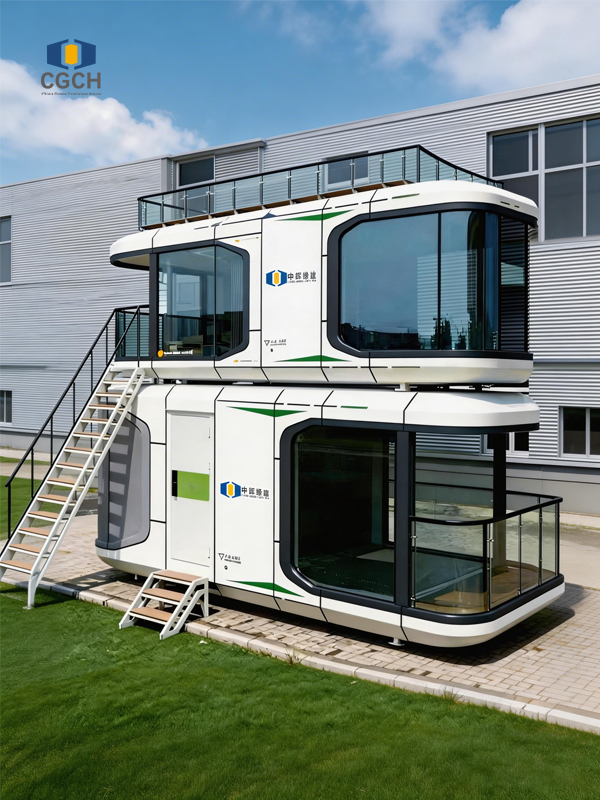
Yes. CGCH produces dedicated two-story glamping pod models with a space-efficient foldable internal staircase. For sites where land area is constrained but you want to maximize room count, this is worth exploring.
Can two adjacent pods be connected into a single larger space?
Yes, using A-series models. CGCH provides detailed connection guidance and remote installation support. For orders of 10 or more units, on-site engineer assistance can be arranged with the buyer covering travel expenses.
How much does ongoing maintenance actually involve?
In practical terms, very little. The aluminum structure does not corrode, does not need repainting, and does not require structural upkeep. Routine care amounts to cleaning the exterior surfaces when they accumulate dust or salt residue. Appliances and glazing carry a one-year warranty; the structural frame and shell are warranted for 30 years.
Is off-grid solar operation possible?
Yes, but it requires a complete off-grid energy system — battery storage, inverter, and panel array — which represents a significant additional investment and needs to be scoped separately. It makes sense for genuinely remote sites where grid connection is not practical. For sites with reliable grid access, the economics of solar typically do not justify the added complexity.
Can exterior colors and interior finishes be customized?
Yes on both counts. Exterior color customization carries an additional charge. Interior finishes — flooring, wall panels, cabinetry — can be selected from CGCH’s standard options catalog. Full OEM support is available for international distributors and large-scale developments, covering custom branding, exterior livery, and interior design packages.
Can I see a glamping pod unit in person before ordering?
Yes. A display unit is available in Poland — contact us to arrange a viewing. For buyers who want a more comprehensive look at the full product range and production process, we recommend visiting the factory directly in Guangdong or Anhui, China. Factory visits can be arranged for qualified buyers.
How to Get Started — Next Steps
Still in the research phase
Email CGCH-CEO@cgchcapsulehouse.com with your project location, approximate number of units, budget range, and target guest profile. We will send a preliminary recommendation within 24 hours — no commitment required.
Ready to move forward
Send your project details to CGCH-CEO@cgchcapsulehouse.com and include your location, target unit count, budget, intended opening date, and local voltage standard. We will come back with a custom configuration proposal, factory pricing, and a shipping cost estimate. If you want to see units in person before finalizing, we can arrange a factory visit in Guangdong or Anhui.
Larger orders of 10 units or more
Volume orders qualify for pricing 8 to 13% below single-unit rates, priority production scheduling, dedicated engineer support on site with buyer covering travel, and full OEM customization covering exterior colors, branding, and interior specification.
Closing
The math on glamping pods and space capsule houses is not complicated. A product that arrives fully fitted, placed on a site with a view worth photographing, priced where it belongs, operated with reasonable competence — that combination works in nearly any market.
From the grasslands of Inner Mongolia to the deserts of Saudi Arabia, the pattern repeats: guests pay a substantial premium to stay somewhere genuinely distinctive, and prefab glamping pods deliver that distinctiveness at a speed and cost basis that conventional construction cannot approach.
CGCH has been manufacturing modular buildings since 2009 and space capsule houses since 2020. Four production facilities across Guangdong, Anhui, Shanghai, and Saudi Arabia, totaling 500,000 square meters of factory floor space, with monthly output exceeding 300 units. Current export markets include Indonesia, the Philippines, Saudi Arabia, the United States, Poland, Germany, and others.
If you are building a glamping project and want a supplier who has delivered across the full range of site conditions and climate challenges, we would like to be part of the conversation.
Email: CGCH-CEO@cgchcapsulehouse.com
Website: cgchcapsulehouse.com
CGCH — Your One-Stop Modular Glamping Pod & Camp Delivery Partner